

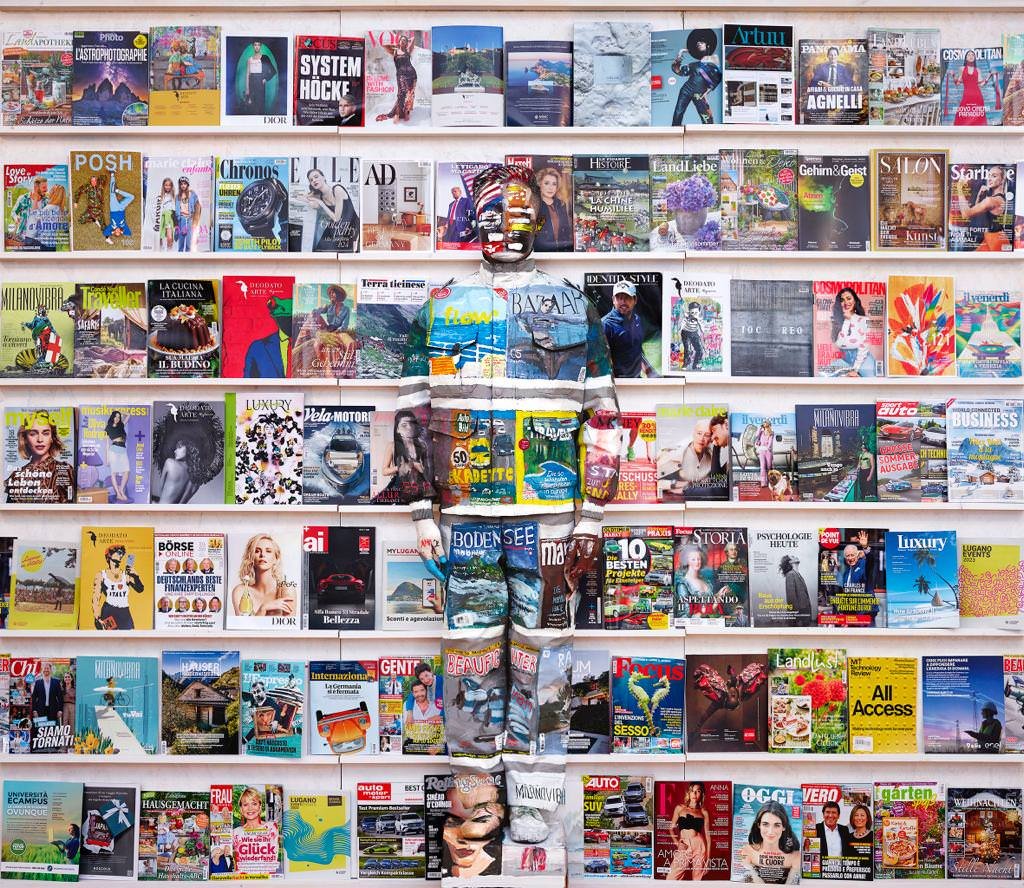
Liu Bolin
«I believe in art that engages with society.»
— Liu Bolin
Biography
Liu Bolin is a Chinese artist whose practice brings together photography, performance, sculpture and painting. Born in Shandong province in 1973 and trained at the Central Academy of Fine Arts in Beijing, he is internationally known as the Invisible Man for works in which his body merges with its surroundings.
His Hiding in the City series began in 2005, following the demolition of the artists’ village where he worked in Beijing. This experience gave rise to a gesture of silent resistance: through a meticulous process of body painting, the artist is painted until he disappears into the background, retaining a presence that viewers are invited to seek out.
Urban landscapes, supermarket shelves, monuments and sites of memory become settings for an exploration of the relationship between the individual and society. Camouflage brings the tensions between identity and conformity, development and erasure into focus, questioning the effects of power and consumerism on contemporary life.
With Hiding in Italy, this exploration enters into dialogue with Italy’s historical and cultural heritage, turning familiar places into questions about human presence and collective memory.
His work has been the subject of exhibitions at Fotografiska in Stockholm, the Maison Européenne de la Photographie in Paris and the Musée de l’Elysée in Lausanne. In Italy, the Complesso del Vittoriano in Rome hosted The Invisible Man in 2018, followed by Visible/Invisible at MUDEC in Milan in 2019. His works are held in collections including the Baltimore Museum of Art and M+ in Hong Kong.
In his images, disappearance becomes a means of drawing attention to the individual and the conditions that determine visibility.

In focusThe work of Liu Bolin
Liu Bolin has turned the disappearance of the body into a distinctive photographic language and a means of political and social reflection. Through meticulous body painting, he blends into his surroundings, making each photograph the outcome of a performance. His signature lies in the tension between presence and absence: viewers must seek out the individual within landscapes, goods and collective symbols. This act of looking makes tangible a question about identity and the conditions that determine its visibility. The precision of his camouflage sustains images that are structurally simple and rich in meaning.